
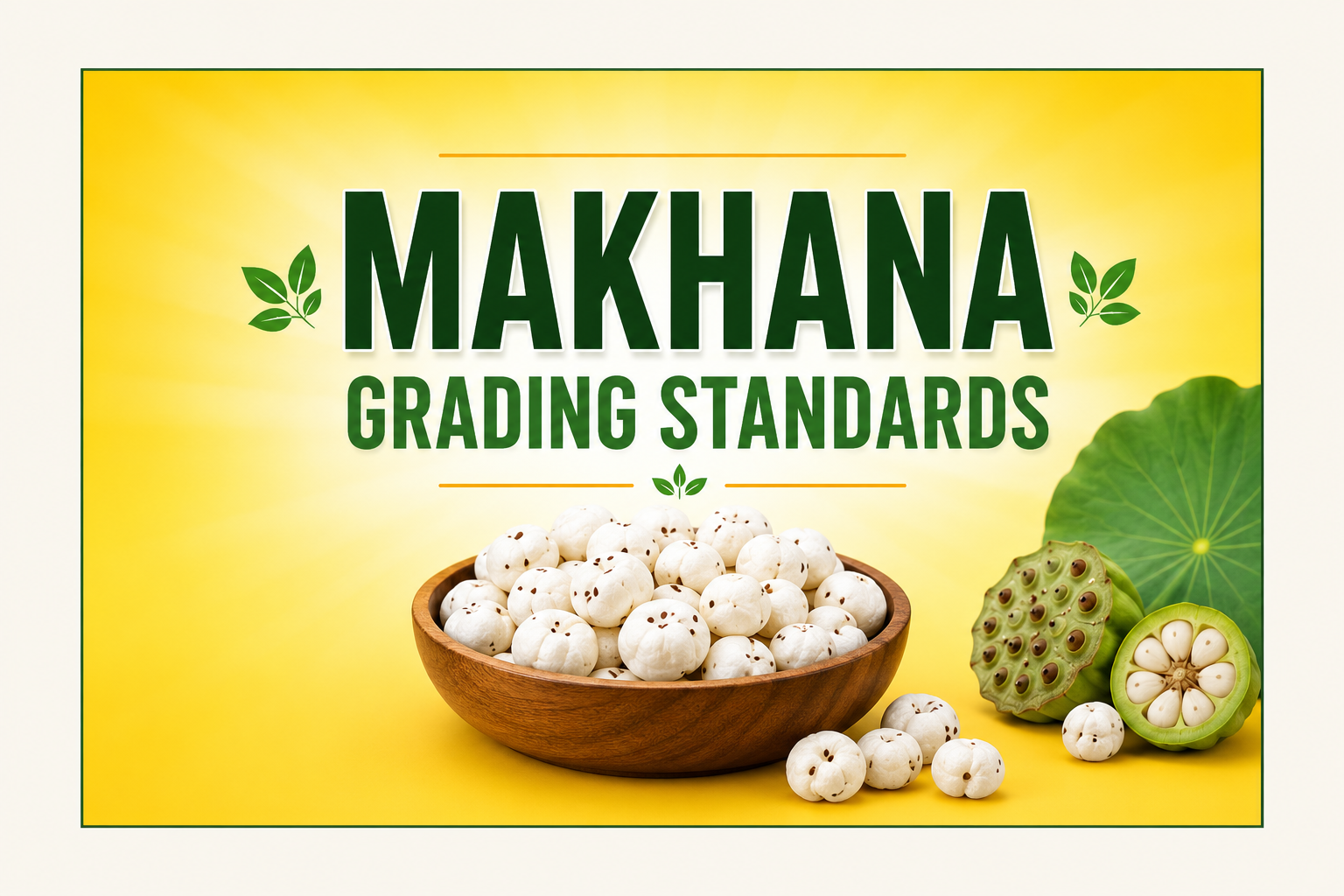
Makhana, also known as fox nuts, popped lotus seeds, or phool makhana, has moved from being a traditional Indian food into a high-demand ingredient for snack brands, wholesalers, private-label companies, food processors, retailers, and international buyers.
For B2B buyers, however, purchasing makhana is not simply about asking for a price per kilogram. Size, grading, popping quality, uniformity, breakage, cleanliness, moisture, sorting method, and intended application can all influence the actual commercial value of a lot.
One of the most important terms buyers encounter in the Indian makhana trade is “Suta.” Understanding the Suta system makes it easier to compare suppliers, evaluate quotations, select the right grade, and avoid paying a premium for a specification that is not clearly defined.
This guide explains the makhana grading system, provides a practical makhana Suta size chart, compares single and mixed grades, explains the factors behind wholesale makhana price per kg, and gives B2B buyers a practical quality checklist before placing a bulk order.
What Is the Suta System in Makhana Grading?
Suta is a traditional size-measurement terminology used in the Indian makhana trade. It refers primarily to the approximate diameter of the popped makhana kernel.
A commonly used conversion is:
1 Suta ≈ 3.175 mm
This means that, approximately:
- 4 Suta ≈ 12.7 mm
- 5 Suta ≈ 15.9 mm
- 6 Suta ≈ 19.1 mm
- 7 Suta ≈ 22.2 mm
The commercial grading of makhana is therefore closely connected with the size of the popped kernel.
However, there is an important point for wholesale buyers:
Suta indicates size; it should not be treated as a complete definition of quality.
Two lots can carry a similar Suta description but differ considerably in whiteness, breakage, cleanliness, uniformity, moisture, popping quality, and overall appearance.
Research examining Suta-based measurement and grading in Bihar has also documented more detailed size bands, showing how approximately 4-4.5 Suta, 4.5-5 Suta, 5-5.5 Suta, 5.5-6 Suta, 6-6.5 Suta and 6.5+ Suta correspond to progressively larger diameter ranges and different commercial applications.
Makhana Suta Size Chart
The following chart is a practical B2B reference based on the traditional Suta-to-diameter relationship. Exact commercial specifications can vary between suppliers, so buyers should always confirm the minimum/maximum diameter and sieve specification in the purchase contract.
| Makhana Grade | Approx. Diameter | General Market Position | Typical Applications |
|---|---|---|---|
| Below 4 Suta | Below ~12.7 mm | Economy / smaller size | Processing, seasoning, ingredients |
| 4 Suta | ~12.7–15.8 mm | Commercial | Roasting, flavouring, food processing |
| 5 Suta | ~15.9–19.0 mm | Standard / premium commercial | Retail snacks, private label, roasting |
| 6 Suta | ~19.1–22.2 mm | Premium | Premium retail, gifting, export |
| 7 Suta+ | ~22.2 mm+ | Extra-large / premium | High-end retail, gifting, specialty export |
A recent research-based assessment of Suta grading in Bihar similarly places 5-5.5 Suta around 15.9-17.4 mm, 5.5-6 Suta around 17.5 -19.0 mm, 6 - 6.5 Suta around 19.1 - 20.7 mm, and 6.5+ Suta above approximately 20.7 mm.
Important: Why Different Size Charts Exist Online
B2B buyers may notice that different suppliers publish slightly different millimetre ranges for the same Suta grade.
This happens because the makhana industry uses traditional trade terminology alongside sieve-based and millimetre-based specifications, and commercial grades may be defined differently depending on whether the supplier is describing a narrow grade, a retained “plus” grade, or a mixed lot.
Therefore, instead of purchasing solely on the statement:
“6 Suta Makhana”
A professional buyer should ask:
- What is the actual diameter range in mm?
- Is this a single grade or a plus grade?
- What percentage of the lot meets the stated size?
- What is the acceptable tolerance?
- What is the broken percentage?
- Is the lot machine sorted or handpicked?
This makes the specification much more precise.
4 Suta, 5 Suta and 6 Suta Makhana: What Is the Difference?
4 Suta Makhana
4 Suta generally represents a smaller commercial size compared with 5 and 6 Suta.
It can be attractive for businesses where cost efficiency and processing economics matter more than premium visual appearance.
Typical applications include:
- Flavoured makhana
- Food processing
- Snack mixes
- Institutional use
- Ingredient applications
- Value-oriented retail products
For large-volume food processors, 4 Suta can sometimes offer better economics because the buyer is not paying the same premium associated with larger kernels.
5 Suta Makhana
5 Suta occupies an important middle-to-premium commercial position.
It offers a useful balance between:
Size + appearance + crunch + cost
This makes it suitable for:
- Branded snack packs
- Private-label products
- Roasted makhana
- Flavoured makhana
- Retail distribution
- General premium snacking
For many brands, 5 Suta can represent an attractive commercial grade because it provides good shelf appearance without necessarily carrying the highest cost associated with jumbo grades.
6 Suta Makhana
6 Suta is a larger premium grade and is often selected when visual appearance and premium positioning are important.
Typical applications include:
- Premium snack brands
- Export-oriented products
- Gourmet packaging
- Corporate gifting
- Premium retail
- High-end private label
Large kernels generally create a stronger visual impression inside a retail pack, particularly when the product is sold as a premium whole-kernel snack.
Research on Suta-based grading has identified larger grades, particularly 6 Suta and above, as commercially relevant for export and premium applications.
Does Higher Suta Always Mean Better Quality?
No.
This is one of the most important points for new B2B buyers.
A larger kernel does not automatically mean a better-quality lot.
A high-grade 6+ Suta lot can still have:
- Excessive breakage
- Poor popping
- Dark or discoloured kernels
- Foreign material
- Uneven sorting
- High moisture
- Stale flavour
- Poor storage history
Likewise, a well-sorted 5 Suta lot can be commercially superior for a particular application.
Therefore, professional procurement should evaluate:
Size + Uniformity + Appearance + Cleanliness + Popping Quality + Moisture + Breakage + Freshness + Documentation
rather than Suta alone.
What Does “6+ Suta” Mean?
The “+” sign requires particular attention when buying in bulk.
In many commercial contexts, a plus grade indicates material at or above a specified sieve threshold, rather than a narrow single-size category.
For example, a supplier may use:
6+ Suta
to indicate makhana meeting a minimum 6-Suta size threshold, meaning the lot can contain kernels larger than the nominal 6-Suta point.
This is commercially different from a narrowly specified 6 Suta band.
Because terminology can vary between suppliers, buyers should not assume that every supplier's “6+” specification has exactly the same composition.
Always ask for:
“Please provide the minimum size in mm and the size distribution/tolerance for this grade.”
That one question can eliminate considerable confusion during procurement.
Single Grade vs. Mixed Grade Makhana
Another important decision for wholesalers and food brands is whether to purchase single-grade or mixed-grade makhana.
What Is Single-Grade Makhana?
Single-grade makhana is sorted into a relatively narrow size category.
For example:
5 Suta - specified diameter range
or
6+ Suta – minimum diameter specification
depending on the supplier's grading methodology.
Advantages of Single Grade
Single-grade material generally offers:
- Better visual uniformity
- More predictable roasting
- Consistent pack appearance
- Easier product positioning
- Better control over retail specifications
- Easier communication with private-label buyers
For premium retail and export-oriented products, consistency can be particularly important.
What Is Mixed-Grade Makhana?
Mixed-grade makhana contains kernels from more than one size category.
A mixed lot may combine different sizes because the buyer prioritizes cost, processing suitability, or overall yield over strict visual uniformity.
Mixed grades can be useful for:
- Food processing
- Flavour coating
- Snack mixes
- Institutional consumption
- Cost-sensitive products
- Products where individual kernel size is less important
The critical point is that “mixed grade” should not mean “poor quality.”
A properly sorted and clean mixed lot can still be commercially useful.
Which Offers Better Margins: Single Grade or Mixed Grade?
There is no universal answer.
The better option depends on your selling model.
For Premium Retail
Single grade is generally more attractive because uniformity improves the appearance of the final pack.
For Private Label
A defined single grade can make quality control and repeat purchasing easier.
For Flavoured Makhana
A mid-size or mixed specification may sometimes provide better economics, depending on the seasoning process and final retail positioning.
For Food Processing
Mixed or lower grades may provide better margins when the application does not require premium whole kernels.
For Export
Buyers should generally prioritize clearly specified, consistent lots rather than simply selecting the largest available Suta grade.
The commercial objective should be:
Buy the grade your customer is willing to pay for - not simply the largest grade available.
What Determines Wholesale Makhana Price Per Kg?
Searching for the wholesale makhana price per kg can produce very different numbers because makhana is not one uniform commodity.
Price depends on multiple variables.
1. Suta Size
Larger kernels are generally more valuable because premium-sized popped kernels are less abundant and command stronger demand in certain markets.
The difference between smaller and premium grades can therefore be significant.
A research-based Bihar market assessment for 2024–25 reported indicative wholesale values ranging from approximately ₹680/kg for 4–4.5 Suta to ₹1,575/kg for 6.5+ Suta, illustrating how strongly price can move with size and grade. These figures are historical reference data, not a current quotation.
2. Grade Consistency
A quotation for “6 Suta” means considerably less if the actual lot contains substantial quantities of smaller kernels.
For B2B procurement, consistency has monetary value.
A supplier offering a slightly higher price for a highly consistent lot may ultimately be cheaper for a brand because it reduces:
- Sorting losses
- Production variability
- Customer complaints
- Pack-to-pack inconsistency
- Rejection risk
- 3. Handpicked vs. Machine-Sorted
Sorting method can affect the final commercial specification.
Handpicked material may command a premium where buyers require stronger visual selection and lower defects, while machine sorting can provide efficiency and repeatability at scale.
Do not assume that “handpicked” automatically means better in every respect. Ask what additional defects are removed and what the resulting specification is.
4. Breakage Percentage
Whole, well-popped kernels generally have greater commercial appeal than excessive broken material.
Before buying, ask the supplier to specify:
Maximum allowable broken percentage.
This is especially important when the product is going into premium retail packaging.
5. Whiteness and Appearance
Good-quality phool makhana should have an acceptable natural appearance appropriate to the grade.
Buyers should watch for:
- Excessive dark spots
- Discolouration
- Burnt pieces
- Shell residues
- Visible foreign matter
- Excessive black or damaged portions
A visually attractive product usually has stronger retail positioning.
6. Moisture
Moisture is an important quality and storage consideration.
Higher moisture can negatively affect crispness and storage stability, particularly when the product is expected to remain crunchy during transportation and warehousing.
Do not accept a supplier's statement such as “dry product” as a complete specification.
Instead, include an agreed moisture specification and test method in your purchase specification.
7. Harvest and Market Conditions
Makhana pricing is influenced by:
- Harvest availability
- Inventory levels
- Seasonal demand
- Grade availability
- Regional sourcing costs
- Labour costs
- Processing costs
- Domestic demand
- Export demand
Consequently, there is no single permanent “wholesale makhana price per kg.”
A quotation should ideally mention:
grade + specification + quantity + packing + delivery basis + validity period
rather than simply stating a price.
8. Order Quantity
A 25 kg purchase, a 500 kg order and a multi-tonne contract will not necessarily receive the same per-kilogram price.
Volume can influence:
- Supplier margin
- Packaging cost
- Processing economics
- Logistics cost
- Negotiation terms
For commercial procurement, always compare suppliers on an apples-to-apples delivered specification.
Frequently Asked Questions About Makhana Grading
What is the Makhana grading system?
The makhana grading system is the process of sorting popped lotus seeds according to size and other commercial quality characteristics. The traditional Indian trade commonly uses Suta terminology for size classification.
What does Suta mean in makhana?
Suta is a traditional measurement term used to describe the approximate diameter of popped makhana. A commonly used conversion is approximately 3.175 mm per Suta.
What is 5 Suta makhana?
5 Suta generally refers to a medium-to-large commercial size, approximately around the 15.9–19 mm diameter range under the traditional Suta conversion. Exact supplier specifications can vary, so buyers should confirm the actual mm range.
What is 6 Suta makhana?
6 Suta generally refers to a larger premium size, approximately around 19.1–22.2 mm under the traditional conversion. It is commonly used for premium retail and other applications where larger kernels are preferred.
Is 6 Suta better than 5 Suta?
Not automatically. 6 Suta is larger and can command a premium, but actual quality also depends on uniformity, cleanliness, breakage, moisture, popping and freshness.
What is 6+ Suta makhana?
6+ generally indicates material meeting or exceeding a 6-Suta threshold. However, the precise composition of a “6+” lot can vary by supplier, so buyers should request the minimum size in millimetres and the applicable tolerance.
What is the wholesale makhana price per kg?
There is no single fixed wholesale price. Price depends on Suta grade, size distribution, quality, sorting, breakage, moisture, quantity, location, processing, packaging, market conditions and commercial terms. Published 2026 market references show wide ranges across grades and locations.
Which makhana grade is best for export?
There is no universal export grade. However, larger, uniform and well-sorted grades such as 6+ and above are often used for premium export applications. The actual requirement should be based on the importer's product specification and destination-market requirements. Research on Suta-based grading has specifically identified larger grades as suitable for export-oriented applications.
Final Takeaway for B2B Makhana Buyers
The Makhana grading system is one of the most important concepts to understand before entering the wholesale or export market.
The Suta system provides a practical way to communicate size, with larger Suta generally corresponding to larger popped kernels. But larger does not automatically mean better.
For commercial procurement, the strongest buying decision comes from evaluating the complete specification:
Suta size → millimetre range → uniformity → popping quality → breakage → moisture → cleanliness → sorting → packaging → price.
If you are comparing wholesale makhana price per kg, never compare the price alone. Compare the quality specification behind the price.
For wholesalers, private-label brands, food processors and importers, a consistent 5 Suta or 6+ Suta specification may ultimately be more valuable than a cheaper but inconsistent mixed lot.
And when buying internationally, the most professional approach is to convert traditional Suta terminology into a clear millimetre-based product specification and agree on measurable quality parameters before the purchase order is issued.
In short: Suta tells you the size. The complete specification tells you the value.
About MakhanaUdyog.com
MakhanaUdyog.com is the export-focused platform of Vitanami, supplying Indian popped lotus seeds / fox nuts / makhana for bulk, wholesale, private-label and export requirements.
Buyers can explore available Makhana Product Grades and discuss grade, quantity, packing and destination-specific requirements before placing a commercial order.
For B2B buyers, the objective is not simply to source the lowest-priced makhana - but to secure consistent grade, dependable quality and repeatable supply.