
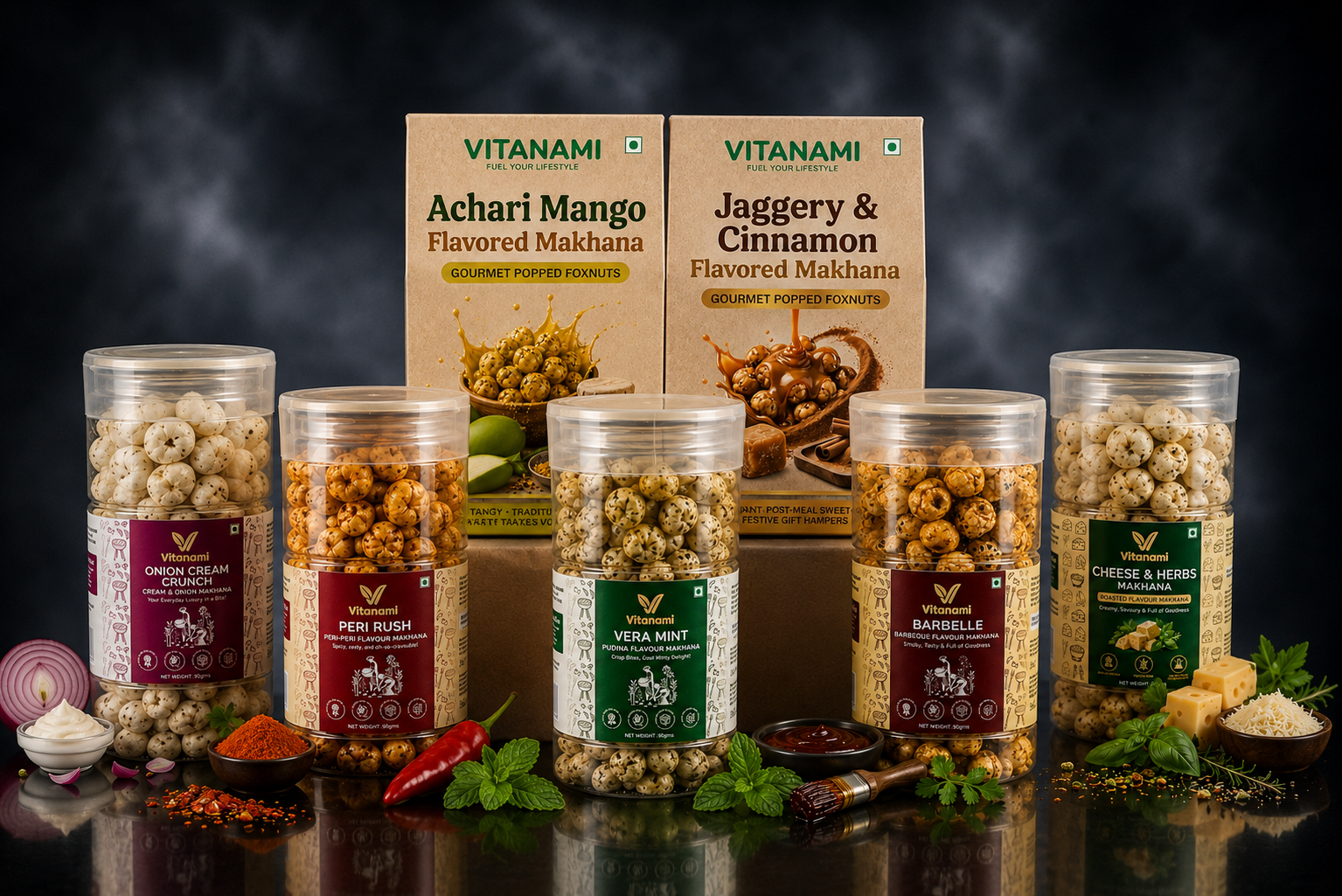
Makhana, also known as Fox Nuts, Foxnuts, Popped Lotus Seeds, or Euryale ferox, is emerging from its traditional Indian roots to become an increasingly interesting ingredient for international snack markets. For German food importers, healthy snack brands, distributors, and private-label companies, Indian Makhana presents an opportunity to explore a crunchy, versatile and differentiated snack category.
Germany has a sophisticated food market where consumers have access to a wide range of nuts, seeds, crisps, crackers and better-for-you snacks. This makes the market competitive—but it also creates an opportunity for distinctive products that offer a combination of taste, convenience, ingredient transparency and product differentiation.
For companies searching for a Makhana supplier in Germany, Fox Nuts exporter from India, or a reliable bulk Makhana supplier for the European market, understanding the product, sourcing process and commercial opportunities is the first step.
What Is Makhana?
Makhana is the popped seed of Euryale ferox, an aquatic plant traditionally cultivated and processed in India. The kernels are commonly roasted and consumed as a crunchy snack, while the product can also be seasoned, flavoured, blended into snack mixes or incorporated into other food applications.
In international markets, Makhana is commonly marketed under names such as:
- Makhana
- Fox Nuts
- Foxnuts
- Popped Lotus Seeds
- Popped Makhana
- Euryale ferox
- Roasted Makhana
- Makhana Snacks
This flexibility in positioning makes Makhana particularly interesting for food companies looking to develop a new snack category or expand an existing healthy-snacking portfolio.
More importantly for European buyers, the regulatory landscape has developed significantly. In 2023, the European Commission authorised roasted and popped kernels from the seeds of Euryale ferox as a traditional food from a third country for placing on the EU market, subject to the applicable conditions and labelling requirements.
That development provides an important foundation for companies evaluating Makhana import opportunities in Germany and the wider European Union.
Why Could Makhana Work in the German Snack Market?
The German snack market already offers consumers an enormous variety of products. From potato chips and pretzels to nuts, seeds and protein-based snacks, consumers have plenty of choices.
So why should German companies consider Makhana?
The answer lies in differentiation.
Makhana is not simply another nut or another roasted snack. Its distinctive appearance, light and crunchy texture, Indian origin and versatility give food companies multiple opportunities to create products that stand apart from conventional snack categories.
For German brands, Makhana can potentially be positioned as:
- A better-for-you snack
- A plant-based snack option
- A crunchy alternative to conventional snacks
- An Indian-origin specialty food
- A premium roasted snack
- A flavoured gourmet snack
- A private-label product
- A component of premium snack mixes
- A foodservice or ingredient product
- A new product category for health-focused consumers
The opportunity is therefore not limited to selling plain Makhana.
The bigger opportunity is building products around Makhana.
Makhana: From Traditional Indian Food to Global Snack Opportunity
Makhana has been consumed in India for generations, particularly in regions where the crop is traditionally cultivated and processed.
India remains the most important sourcing market for commercial Makhana, giving international buyers access to established agricultural, processing and export supply chains.
For European companies, sourcing directly from an experienced Indian Makhana exporter can provide access to different kernel sizes, grades, processing formats, flavours and packaging options.
This is particularly relevant for companies that do not want to simply purchase a finished consumer product.
Instead, a German importer may want to source:
Raw or plain Makhana → Roast locally → Season → Pack under its own brand → Distribute across Germany or Europe
This creates significantly more commercial flexibility.
Why German Importers May Consider Indian Makhana
For a German food importer, sourcing decisions usually involve more than simply finding the lowest price.
Product consistency, specifications, documentation, food safety, packaging, logistics and supplier reliability can all influence the decision.
A professional Makhana exporter from India should therefore be able to discuss:
1. Product Grade
Makhana is available in different kernel sizes and grades.
Larger, more uniform kernels can be particularly suitable for premium retail positioning, while smaller or assorted grades may work for processing, seasoning, snack mixes or other applications.
A buyer should receive clear specifications covering:
- Kernel size
- Approximate kernel count per kilogram
- Appearance
- Colour
- Texture
- Cleaning and sorting
- Processing method
- Flavouring, where applicable
- Packaging
- Shelf life
- Batch information
2. Consistent Quality
For a German importer, receiving a high-quality sample once is not enough.
The supplier needs to demonstrate the ability to maintain consistency across commercial shipments.
This makes quality control and batch-to-batch consistency important considerations when selecting an Indian Makhana supplier.
3. Food-Safety Documentation
European food businesses generally need appropriate documentation and controls around imported food products.
Depending on the product, buyer and destination requirements, commercial discussions may include specifications and testing relating to areas such as:
- Microbiological parameters
- Heavy metals
- Pesticide residues
- Product composition
- Packaging suitability
- Traceability
- Certificate of Analysis
- Other buyer-specific testing requirements
German buyers should always establish the exact compliance and documentation requirements applicable to their intended product and route of import.
Makhana vs Traditional Snack Categories
One of the most interesting commercial questions is how Makhana can compete with familiar snack products.
Makhana should not necessarily be positioned as a direct replacement for every snack.
Instead, it can create a new premium snack proposition.
| Snack Category | Common Positioning | Makhana Opportunity |
|---|---|---|
| Potato Chips | Crispy, flavoured, indulgent | Alternative crunchy snack |
| Popcorn | Light, crunchy, flavoured | Similar snack occasion with a different product |
| Peanuts | Protein-rich, familiar | Premium alternative / snack mix |
| Mixed Nuts | Premium, nutritious | Ingredient for premium blends |
| Crackers | Convenient snack | Different texture and format |
| Protein Snacks | Fitness-oriented | Complementary better-for-you positioning |
| Makhana | Novel, crunchy, versatile | New product category |
The commercial opportunity is therefore not simply:
“Makhana vs Chips.”
It is:
“Where can Makhana create a new reason for consumers to buy?”
Flavoured Makhana: A Major Opportunity for German Snack Brands
Plain roasted Makhana is only the beginning.
Flavour development can transform Makhana into a highly marketable snack product.
For German and European brands, possible flavour directions include:
- Peri-Peri
- Cream & Onion
- Mint / Pudina
- Smoky Barbecue
- Cheese & Herbs
- Jaggery & Cinnamon
- Mango-inspired or Achari flavours
- Salted and lightly seasoned varieties
- Custom seasoning blends
This creates opportunities for both Indian-inspired flavours and flavours designed specifically for European consumers.
A German snack company could therefore source Makhana in bulk and develop its own seasoning profile, or work with an experienced exporter to develop a ready-to-pack flavoured product.
This is particularly attractive for private-label Makhana.
Private-Label Makhana: A Business Opportunity for German Brands
Private label could be one of the most commercially interesting opportunities for Makhana in Germany.
Instead of building a manufacturing operation from scratch, a German retailer, distributor, health-food company or snack brand can work with an Indian supplier to develop a product under its own brand.
Potential private-label formats include:
Retail Pouches
Suitable for supermarkets, specialty food stores, organic-oriented retailers and online marketplaces.
Premium Jars
Useful for premium positioning and gifting-oriented product concepts.
Single-Serve Packs
Potentially suitable for convenience, offices, travel and foodservice applications.
Bulk Packs
Suitable for distributors, foodservice operators and repacking companies.
Flavoured Snack Ranges
A brand can develop multiple SKUs around different flavours.
For example:
Classic Roasted Makhana
Peri-Peri Makhana
Cream & Onion Makhana
Smoky Barbecue Makhana
Cheese & Herbs Makhana
This allows one raw ingredient to become an entire product portfolio.
Bulk Makhana Import: An Opportunity Beyond Retail
Not every German buyer wants finished retail packaging.
Food manufacturers, distributors, repackers and snack companies may prefer bulk Makhana from India.
Bulk Makhana can be supplied for:
- Repacking
- Local roasting
- Seasoning
- Snack manufacturing
- Private-label production
- Snack mixes
- Foodservice
- Ingredient applications
- Wholesale distribution
This is where the role of a reliable B2B Makhana exporter becomes particularly important.
A buyer may initially require only a small sample shipment before moving toward larger commercial quantities.
A structured sourcing process can therefore look like:
Sample → Product Approval → Testing → Commercial Specification → Trial Order → Regular Import
Why Product Grade Matters When Importing Makhana
One of the biggest mistakes a new buyer can make is treating all Makhana as the same product.
It isn't.
Different kernel sizes and grades can produce different commercial outcomes.
For example, premium large kernels may be better suited for:
- Premium retail
- Gourmet snacks
- High-end private labels
- Gift packs
- Direct-to-consumer products
Medium-sized kernels may be suitable for:
- Mainstream snack products
- Flavoured Makhana
- Snack mixes
- Food processing
Assorted grades can potentially be used for:
- Processing
- Blending
- Seasoning
- Value-oriented applications
Therefore, German importers should define their target application before finalising the Makhana grade.
What Should German Importers Check Before Buying Makhana from India?
Selecting an exporter purely on price can create problems later.
A professional sourcing evaluation should consider at least the following:
Product Specifications
Does the supplier provide precise kernel size and quality specifications?
Sampling
Can the buyer evaluate a representative sample before placing a commercial order?
Testing
Can appropriate laboratory testing and documentation be arranged according to the buyer's requirements?
Traceability
Can the supplier provide batch-level information and traceability?
Packaging
Can the product be supplied in bulk or customised/private-label packaging?
Shelf Life
Does the available shelf life fit the buyer's distribution and import requirements?
Export Experience
Does the supplier understand international documentation and shipment requirements?
Communication
Can the supplier provide timely and clear responses throughout the sourcing process?
Scalability
Can the supplier support the buyer when the business moves from trial quantities to regular commercial orders?
These factors can be much more important than simply finding the cheapest quotation.
EU Food Compliance: An Important Consideration for Makhana Buyers
For businesses importing Makhana into Germany, regulatory compliance should be addressed before commercial shipment.
The European Commission's Implementing Regulation (EU) 2023/652 authorised roasted and popped kernels from Euryale ferox as a traditional food from a third country under the EU Novel Food framework. The regulation also specifies the applicable conditions and a designation for the authorised novel food on labels of foods containing it.
This is an important distinction for businesses entering the European market.
However, authorisation of the food does not mean that every finished Makhana product automatically meets every EU or German requirement.
Importers should evaluate the complete product, including:
- Ingredients
- Seasonings
- Additives
- Allergen declarations
- Nutrition information
- Packaging
- Labelling
- Contaminant limits
- Microbiological requirements
- Pesticide requirements
- Import documentation
- Traceability
- Country-specific buyer requirements
For flavoured Makhana in particular, the seasoning formulation needs to be evaluated separately from the plain product.
Why Direct Sourcing from India Can Make Sense
India is the natural sourcing market for Makhana because of its established production and processing ecosystem.
For German companies, direct B2B sourcing can offer greater control over:
Grade + Quantity + Processing + Flavour + Packaging + Private Label
Instead of purchasing a finished product through multiple intermediaries, a buyer can work directly with an export-oriented supplier.
This can be particularly useful for companies planning to build a long-term Makhana category.
A direct supplier relationship can also make it easier to discuss:
- Custom specifications
- Trial orders
- Bulk quantities
- Custom seasoning
- Packaging formats
- Private label
- Long-term supply
- Product development
- MakhanaUdyog: Sourcing Indian Makhana for International Markets
MakhanaUdyog is the export-focused platform of Vitanami, specialising in Indian Makhana for international B2B buyers.
The focus is not simply on selling Makhana.
The objective is to help international buyers source the right product for their specific application.
MakhanaUdyog offers product categories including:
- Premium-grade Makhana
- Large-kernel Makhana
- Standard-grade Makhana
- Assorted Makhana
- Flavoured Gourmet Makhana
- Bulk Makhana for repacking
- Ready-to-sale flavoured Makhana
- Private-label and OEM solutions
For buyers evaluating Makhana import from India to Germany, the ability to discuss both raw material and finished-product requirements can simplify the sourcing process.
From Germany to the Rest of Europe
Germany can also serve as a strategically important market for companies looking to develop a broader European Makhana business.
A German importer or distributor may potentially build a network across multiple European markets once the product, packaging, compliance and commercial model have been validated.
This creates an opportunity for:
Indian Makhana Supplier → German Importer → Distributor → Retail / E-Commerce / Foodservice → European Consumers
For an established distributor, Makhana can become another category within an existing healthy-snack portfolio.
For a startup, it can become the foundation of a new snack brand.
For a retailer, it can become a differentiated private-label product.
For a food manufacturer, it can become an ingredient for innovative snack formulations.
Is Makhana the Next Big Healthy Snack from India?
It may be too early to call Makhana the “next big snack” in Germany.
But the commercial opportunity is difficult to ignore.
Makhana combines several characteristics that can make a new food category attractive:
Distinctive origin + crunchy texture + versatile flavouring + multiple grades + flexible packaging + private-label potential.
And unlike many emerging food trends, Makhana already has a long history of consumption in India and an established supply base.
The European Union's 2023 authorisation of roasted and popped Euryale ferox kernels as a traditional food from a third country also provides an important regulatory milestone for businesses evaluating the category.
The next challenge is not whether Makhana can be exported.
It is whether brands can successfully position, package, flavour and distribute it for European consumers.
How German Companies Can Start Importing Makhana from India
For companies interested in entering the category, the best approach is usually to start with a clearly defined product specification.
Step 1: Define the Product
Decide whether you need:
- Plain Makhana
- Roasted Makhana
- Flavoured Makhana
- Bulk Makhana
- Private-label Makhana
- Custom-seasoned Makhana
Step 2: Select the Grade
Choose the appropriate kernel size and quality based on your intended application.
Step 3: Request Samples
Evaluate appearance, crunch, flavour, seasoning and overall product quality.
Step 4: Establish Specifications
Agree on product parameters, packaging, shelf life, testing and documentation.
Step 5: Conduct Buyer-Specific Compliance Checks
Confirm the requirements applicable to your German/EU product and import model.
Step 6: Start With a Trial Order
A controlled commercial trial can help validate logistics, packaging, quality and customer response.
Step 7: Scale
Once the product has been validated, move toward regular bulk imports or private-label production.
The Opportunity for German Importers, Distributors and Private-Label Brands
The strongest opportunity may not be selling Makhana as another “healthy snack.”
It may be about creating a new premium snacking experience around an ingredient that most European consumers are still discovering.
For German companies, that creates several possible business models:
Import & Distribute
Source bulk Makhana from India and distribute to retailers and food businesses.
Private Label
Develop a branded Makhana range under your own brand.
Flavoured Snack Brand
Create a portfolio of differentiated Makhana flavours.
Health & Specialty Food
Position Makhana within a better-for-you or specialty snack portfolio, subject to compliant product claims.
Food Manufacturing
Use Makhana as an ingredient in innovative snack formulations.
The most successful companies are likely to be those that combine quality sourcing with strong product positioning.
Final Thoughts
Makhana is moving beyond its traditional Indian identity and entering conversations around international snacking, private label and better-for-you food innovation.
For German importers, distributors and snack brands, the opportunity is particularly interesting because Makhana offers something many established snack categories cannot easily provide: novelty combined with an established Indian supply chain.
Whether you are looking for bulk Makhana from India, premium Fox Nuts, roasted Makhana, flavoured Makhana, private-label Makhana or an OEM Makhana supplier, the first step is finding a supplier capable of matching the product to your exact commercial requirements.
For businesses exploring the German and wider European market, the opportunity is not simply to import another snack.
It is to build a new Makhana category.
Looking to Source Makhana from India?
MakhanaUdyog works with international B2B buyers looking for Indian Makhana for bulk supply, repacking, flavoured products and private-label applications.
Explore the range of Indian Makhana grades and export products, or contact MakhanaUdyog to discuss your requirements for the German and European market.
MakhanaUdyog — Your Export Partner for Premium Indian Makhana.