
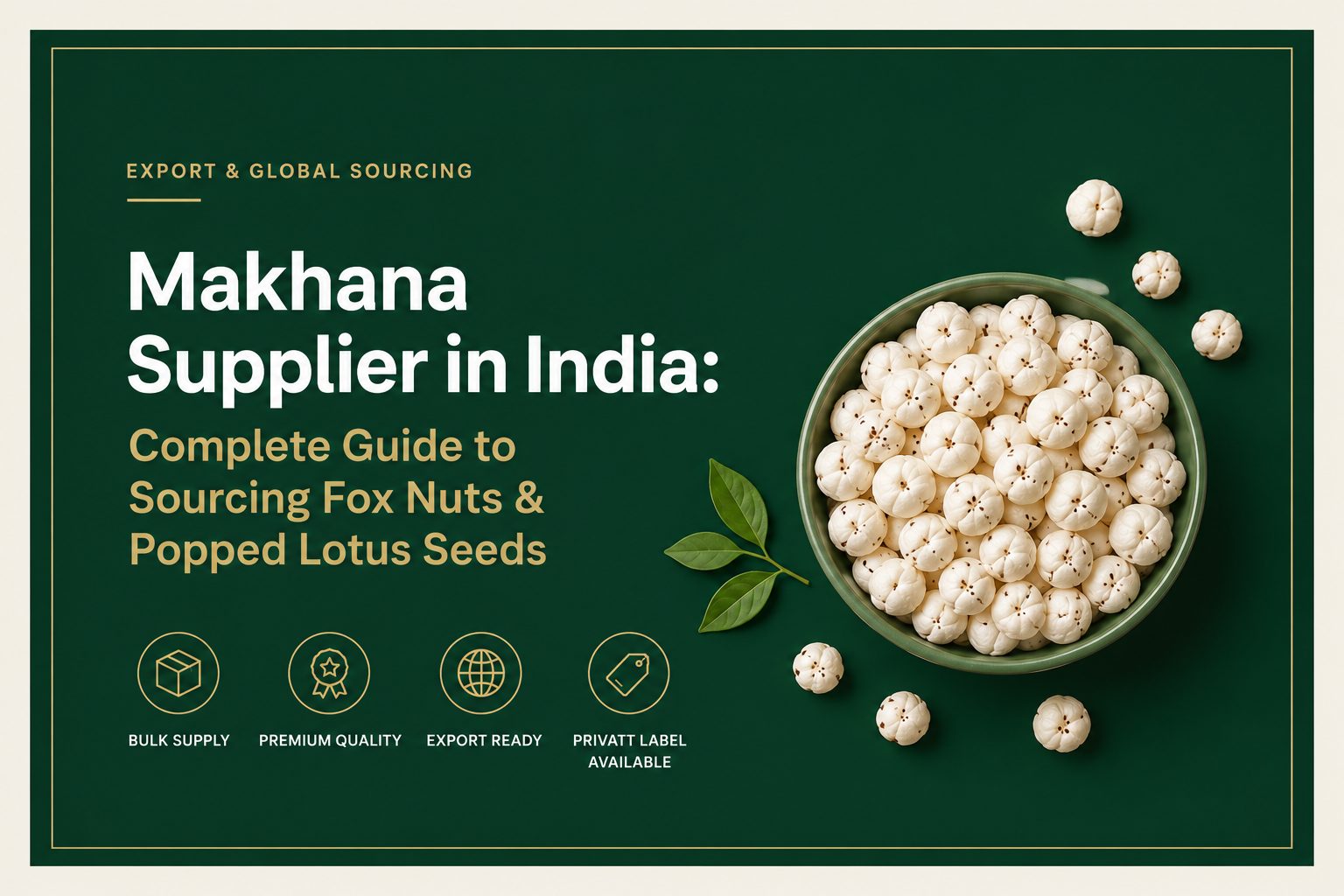
Makhana Supplier in India: Complete Guide to Sourcing Fox Nuts & Popped Lotus Seeds
Makhana. Fox Nuts. Popped Lotus Seeds. Phool Makhana. Lotus Seeds.
European buyers may use different names when searching for this increasingly popular Indian snack and food ingredient. But behind these different search terms is often the same requirement: a reliable Indian supplier capable of providing consistent quality, export-ready packing, suitable grades, documentation and dependable bulk supply.
For importers, distributors, wholesalers, snack manufacturers, food businesses and private-label brands in Europe, choosing the right Makhana supplier in India is about much more than finding the lowest price.
The right supplier should be able to understand your required kernel size, grade, application, packaging, quantity, quality parameters and destination-market requirements—and translate those requirements into a consistent export specification.
This guide explains how European buyers can evaluate and source Makhana, Fox Nuts and Popped Lotus Seeds from India, what grades are available, what to ask an Indian supplier, how bulk supply works, and what to consider before placing an order.
What Is Makhana? Understanding Fox Nuts, Popped Lotus Seeds & Phool Makhana
Makhana is the edible popped seed of the Euryale ferox plant and is widely known in international markets by several names.
Depending on the country, buyer or search query, you may encounter:
- Makhana
- Fox Nuts
- Foxnuts
- Popped Lotus Seeds
- Lotus Seeds
- Popped Lotus Seed
- Phool Makhana
- Euryale ferox seeds
- Indian Fox Nuts
- Indian Popped Lotus Seeds
For B2B sourcing purposes, Makhana, Fox Nuts and Popped Lotus Seeds are particularly important terms.
A European buyer searching for:
“Fox Nuts supplier India”
may be looking for exactly the same product as a buyer searching:
“Popped Lotus Seeds supplier India”
This is why an experienced Indian exporter should clearly communicate all relevant product terminology rather than relying on the word “Makhana” alone.
Why European Buyers Are Looking for Makhana Suppliers in India
Makhana has traditionally been consumed in India, but its use is increasingly extending into international snack, health-food, ethnic-food and food-ingredient markets.
European businesses may source Makhana for:
- Healthy snack brands
- Natural food products
- Ethnic food distribution
- Roasted snack products
- Flavoured snack ranges
- Snack mixes
- Trail mixes
- Food processing
- Ingredient applications
- Private-label products
- Retail-ready products
- Repacking and distribution
This creates several different B2B search intents.
A buyer may search for:
Makhana supplier India
Makhana exporter India
Fox Nuts supplier India
Fox Nuts exporter India
Popped Lotus Seeds supplier India
Popped Lotus Seeds exporter India
Bulk Makhana supplier India
Makhana wholesale supplier India
Indian Fox Nuts supplier
Makhana private label supplier India
Although the wording is different, these searches all indicate a potential commercial sourcing requirement.
What Makes India an Important Source of Makhana?
India is the principal source of commercial Makhana and has a long-established cultivation, processing and trading ecosystem.
The Bihar region is particularly important to the Indian Makhana industry, with major production and processing activity associated with areas such as Mithila, Darbhanga, Madhubani and surrounding regions.
For international buyers, sourcing from India can provide access to:
- Multiple Makhana grades
- Different kernel sizes
- Bulk supply
- Hand-sorted selections
- Raw and unflavoured Makhana
- Flavoured Makhana
- Export-oriented packaging
- Private-label possibilities
- B2B quantities
- Product customization
However, Indian origin alone does not guarantee consistent quality.
The supplier's sourcing network, grading process, quality controls, packaging standards and export experience matter just as much.
How to Find a Reliable Makhana Supplier in India
Finding a supplier is easy.
Finding a supplier that can consistently deliver the same specification you approved is much more important.
Before choosing an Indian Makhana supplier, European buyers should evaluate at least the following:
1. Product Specification
Ask for a detailed specification rather than simply asking:
“What is your Makhana price?”
The specification should explain the product being quoted.
Depending on the grade, this may include:
- Kernel size
- Approximate kernels per kilogram
- Colour
- Uniformity
- Broken percentage
- Moisture
- Foreign matter
- Physical appearance
- Processing method
- Flavouring, if applicable
- Packaging format
- Shelf life
2. Grade Consistency
A supplier should be able to clearly explain the difference between its grades.
Do not compare two suppliers solely by names such as “Premium,” “Gold” or “Super.”
Compare the actual physical specification.
3. Quality Testing
For European B2B supply, buyers may request laboratory testing relevant to the product and destination market.
Depending on the buyer's requirements, discussions can include:
- Microbiological testing
- Heavy metals
- Pesticide residues
- Mycotoxins
- Other contaminant parameters
- Product-specific testing requested by the buyer
The exact testing programme should be agreed according to the product, destination and buyer's compliance requirements.
4. Traceability
A professional supplier should be able to provide appropriate lot or batch identification and maintain records supporting traceability.
5. Export Documentation
Discuss documentation requirements before confirming an order.
Depending on the transaction and destination, buyers may require commercial and export documents and, where applicable, certificates or laboratory reports.
6. Packaging Capability
Ask whether the supplier can provide:
- Bulk cartons
- Bulk bags
- Food-grade inner packaging
- Retail-ready packs
- Private-label packaging
- Custom packaging
- Repacking formats
7. Communication
A good export supplier should be able to answer technical questions clearly.
If a supplier cannot explain its own product specification, grade or testing, that should be treated as a warning sign.
Makhana Grades: What European Buyers Should Understand
One of the most important factors when sourcing Makhana is kernel size and grade.
Makhana is not a single uniform commodity.
Different sizes and grades can be suitable for different commercial applications.
For example:
Premium / Jumbo Makhana
Larger, more visually uniform kernels can be suitable for:
- Premium retail
- Gourmet snacks
- Premium private label
- Gift packs
- High-end snack applications
Large Makhana
Large kernels may be suitable for:
- Retail snack packs
- Roasted Makhana
- Flavoured Makhana
- Premium snack mixes
Medium Makhana
Medium-sized kernels can be suitable for:
- Snack mixes
- Food processing
- Bulk applications
- Seasoned products
- Cost-sensitive formulations
Assorted Makhana
Assorted grades can be considered for applications where uniform kernel size is less critical.
Important: Grade names are not universal.
One supplier's “Premium Grade” may not be identical to another supplier's “Premium Grade.”
For this reason, always compare millimetres, kernel count, physical appearance and other agreed parameters, rather than relying only on grade names.
How Makhana Size Is Communicated to Buyers
Indian Makhana suppliers may use traditional grade terminology alongside modern commercial specifications.
For international buyers, a clear specification based on measurable characteristics is often easier to understand.
For example:
Premium Grade – Jumbo Kernels
- Approx. size: 19+ mm
- Approx. kernel count: 600–700 kernels/kg
- Appearance: Uniform bright white
- Application: Premium retail, gourmet snacks and private label
Actual specifications should always be confirmed against the particular production lot.
This type of specification makes it easier for an importer in Germany, Netherlands, Poland, France, Spain, Italy or another European market to compare quotations from different suppliers.
Bulk Makhana Supplier in India
For B2B buyers, bulk Makhana supply is often more relevant than consumer-sized packs.
A European importer may purchase Makhana for:
- Repacking
- Wholesale distribution
- Private-label production
- Food manufacturing
- Snack production
- Retail distribution
- Ingredient applications
Bulk packaging can be customized according to the buyer's requirements.
Common commercial discussions include:
- MOQ
- Packaging size
- Number of cartons
- Pallet configuration
- Product grade
- Shipping terms
- Destination port
- Lead time
- Sample approval
- Production schedule
The most suitable packaging depends on whether the buyer intends to repack the product in Europe or sell it in the original export packaging.
Makhana Wholesale Supplier vs Makhana Exporter
These terms are sometimes used interchangeably, but they can represent different capabilities.
A wholesaler may primarily focus on domestic bulk supply.
An exporter should be capable of handling the additional requirements associated with international transactions.
For an EU buyer, questions worth asking include:
- Have you supplied internationally before?
- Can you provide export documentation?
- Can you prepare buyer-specific specifications?
- Can you arrange laboratory testing?
- Can you supply samples?
- Can you provide bulk packaging?
- Can you support private-label requirements?
- Can you maintain consistent specifications between lots?
- Can you communicate clearly throughout the export process?
For a European importer, the best supplier is not necessarily the largest company.
It is the supplier that can reliably meet the buyer's exact specification and commercial requirements.
Makhana Supplier for European Buyers
European buyers can approach Indian Makhana suppliers for several different business models.
1. Bulk Import
The buyer imports Makhana in bulk and handles repacking or processing in Europe.
This is suitable for:
- Importers
- Distributors
- Wholesalers
- Food manufacturers
2. Private Label
The Indian supplier produces or packs the product according to the buyer's brand requirements.
This can include:
- Product selection
- Flavour
- Pack size
- Artwork
- Packaging
- Labelling requirements
Private-label projects should be discussed early because packaging, artwork, minimum quantities and lead times can differ substantially from standard bulk orders.
3. Retail-Ready Makhana
The supplier provides finished consumer packs suitable for the buyer's distribution model, subject to the applicable destination-market requirements.
4. Ingredient Supply
Food manufacturers may purchase Makhana as an ingredient for:
- Snack mixes
- Cereals
- Functional snack products
- Flavoured snack products
- Food formulations
Makhana Private Label Supplier in India
Private-label Makhana is particularly relevant for European brands that want to develop their own snack range without establishing their own manufacturing or sourcing operation in India.
A private-label project can involve:
Product → Grade → Flavour → Pack size → Packaging → Artwork → Labelling → Testing → Production → Export
Before requesting a private-label quotation, buyers should ideally provide:
- Target market
- Product type
- Desired grade
- Pack size
- Approximate annual volume
- Flavour requirements
- Packaging preference
- Retail channel
- Target launch date
The more precise the brief, the more accurately an Indian supplier can quote.
Flavoured Makhana Supplier from India
In addition to plain or unflavoured Makhana, European buyers may look for suppliers of flavoured Fox Nuts or ready-to-eat snack products.
Potential flavour categories include:
- Peri-Peri
- Cream & Onion
- Mint
- Barbecue
- Cheese & Herbs
- Mango / Achari
- Jaggery & Cinnamon
- Custom seasoning blends
For flavoured products, buyers should additionally evaluate:
- Seasoning uniformity
- Ingredient declaration
- Allergen information
- Flavour consistency
- Pack format
- Shelf life
- Microbiological requirements
- Destination-market labelling requirements
What Should You Ask a Makhana Supplier Before Buying?
A serious buyer should send a structured enquiry instead of asking only for a price.
Here is a useful supplier enquiry framework.
Product
- What Makhana grades do you supply?
- What kernel sizes are available?
- What is the approximate kernel count per kg?
- Is the product raw, roasted or flavoured?
- What is the broken percentage?
- What is the moisture specification?
Quality
- What quality parameters are controlled?
- What laboratory tests are available?
- Can you provide a Certificate of Analysis where required?
- What is the lot/batch traceability system?
- What is the shelf life?
Commercial
- What is the MOQ?
- What are the sample quantities?
- What is the bulk price?
- What packaging options are available?
- What are the production lead times?
Export
- Which countries have you supplied?
- Can you support export documentation?
- Which Incoterms can you offer?
- Which ports can you ship from?
- Can you arrange buyer-specific testing?
Private Label
- Can you provide retail-ready packaging?
- Can you produce under a buyer's brand?
- Can you support artwork and packaging requirements?
- What is the private-label MOQ?
Makhana Sample Before Bulk Order
For a new supplier relationship, a sample should ideally be evaluated before committing to a substantial commercial order.
A buyer can compare:
Appearance
Is the product clean, bright and reasonably uniform?
Size
Does the physical size match the quoted grade?
Texture
Is the product crisp and appropriate for the intended application?
Taste
Is the flavour clean and characteristic?
Broken kernels
Is the proportion acceptable for the intended use?
Packaging
Does the packaging provide adequate protection during transport and storage?
Documentation
Does the supplier provide the agreed specification and supporting documents?
For serious B2B sourcing, the approved sample should be connected to a clearly defined commercial specification.
Makhana Quality: What EU Buyers Should Look For
European buyers should not evaluate Makhana only by visual appearance.
A robust purchasing specification may address:
- Physical quality
- Kernel size
- Colour
- Uniformity
- Moisture
- Broken percentage
- Foreign matter
- Microbiological parameters
- Pesticide residues
- Heavy metals
- Mycotoxins and other applicable contaminants
- Packaging integrity
- Traceability
- Shelf life
The precise requirements should be agreed according to the product and intended use.
EU food legislation establishes requirements and maximum levels for various contaminants, and imported food is subject to official controls. Buyers should therefore establish the applicable requirements for their specific product and destination before shipment.
EU Compliance and Makhana Imports
A professional Indian supplier should understand that supplying food to Europe involves more than putting the product into a carton and shipping it.
EU buyers should verify the applicable requirements for:
- Food safety
- Contaminants
- Pesticide residues
- Microbiological criteria
- Labelling
- Traceability
- Packaging and food-contact materials
- Import procedures
- Border controls
- Product-specific restrictions or increased controls, where applicable
The European Commission's official Access2Markets portal provides information on tariffs, rules of origin, import procedures and product requirements.
The responsibility for ensuring that a particular shipment meets the applicable EU and national requirements ultimately depends on the parties, product and transaction structure.
Why Laboratory Testing Matters When Buying Makhana from India
A supplier quotation tells you what the supplier intends to sell.
A laboratory report can provide objective evidence about specified parameters in the tested lot.
For European B2B buyers, testing may be requested for parameters such as:
- Microbiology
- Heavy metals
- Pesticide residues
- Mycotoxins
- Other contaminants
- Buyer-specific parameters
Testing requirements should be agreed before production or shipment where possible.
For repeat orders, buyers may also establish a testing protocol so that quality is monitored consistently from shipment to shipment.
Makhana Packaging for Export
Packaging should protect the product throughout:
Processing → Packing → Warehousing → Inland Transport → Ocean Freight → Import → Distribution
Depending on the commercial model, Makhana may be supplied in:
- Bulk cartons
- Food-grade inner bags
- Large bulk packs
- Retail pouches
- Private-label consumer packs
- Custom packaging formats
European repackers may prefer bulk packaging because it gives them greater flexibility over final retail presentation.
A supplier should discuss packaging based on:
- Quantity
- Product type
- Shelf life
- Shipping method
- Destination
- Storage conditions
- Repacking requirements
Makhana Shelf Life
Shelf life is an important commercial consideration for international buyers.
A European importer may need sufficient remaining shelf life to accommodate:
Production → Export → Transit → Customs → Warehousing → Repacking → Retail distribution → Consumer purchase
Therefore, buyers should ask:
- What is the declared shelf life?
- From which date is shelf life calculated?
- What is the expected remaining shelf life at dispatch?
- What packaging is used to preserve product quality?
- What storage conditions are recommended?
Shelf-life expectations should be agreed before the purchase order.
Makhana MOQ: How Much Can You Buy?
Minimum order quantities vary by supplier and product.
A standard unflavoured bulk order can have a different MOQ from:
- Flavoured Makhana
- Private-label Makhana
- Custom packaging
- Retail-ready products
- Custom formulations
For a first transaction, some suppliers may offer samples or smaller commercial lots before moving toward larger volumes.
When requesting a quotation, specify:
Product + Grade + Quantity + Packaging + Destination
For example:
Premium Jumbo Makhana, 19+ mm, unflavoured, bulk packaging, 500 kg, delivery to Europe.
This will generally produce a much more useful quotation than:
“Please send Makhana price.”
How to Compare Makhana Suppliers in India
Price should not be the only comparison point.
Consider creating a supplier comparison based on:
| Factor | Supplier A | Supplier B | Supplier C |
|---|---|---|---|
| Product Grade | |||
| Kernel Size | |||
| Broken % | |||
| Moisture | |||
| Testing | |||
| Shelf Life | |||
| MOQ | |||
| Packaging | |||
| Private Label | |||
| Export Experience | |||
| Lead Time | |||
| Price |
The cheapest supplier is not necessarily the lowest-cost supplier if inconsistent quality results in rejected goods, repacking problems, customer complaints or lost retail opportunities.
Makhana Supplier in India for Germany, Netherlands, Poland & Other European Markets
Search behaviour can vary from country to country.
A German buyer might search:
Makhana supplier Germany
Fox Nuts supplier Germany
Popped Lotus Seeds supplier Germany
while an importer in the Netherlands may search:
Makhana importer Netherlands
Fox Nuts supplier Netherlands
Makhana wholesale Netherlands
A Polish buyer may use:
Makhana supplier Poland
Fox Nuts importer Poland
Popped Lotus Seeds Poland
Similar commercial searches can occur across:
- Germany
- Netherlands
- Poland
- France
- Belgium
- Spain
- Italy
- Austria
- Sweden
- Denmark
- Finland
- Czech Republic
- Ireland
- Other European markets
The terminology may change, but the purchasing requirement remains similar: a dependable source of Indian Makhana that can meet the buyer's specification and commercial requirements.
Makhana Supplier, Exporter or Manufacturer: Which Should You Choose?
There is no single answer.
A European importer should choose a business based on its ability to fulfil the specific requirement.
For example:
Choose based on sourcing capability when:
You need consistent bulk supply across multiple grades.
Choose based on processing capability when:
You need roasted, seasoned or flavoured Makhana.
Choose based on export capability when:
You require international documentation, packaging and logistics coordination.
Choose based on private-label capability when:
You want to build your own European retail brand.
In many cases, the ideal partner can coordinate several of these functions rather than leaving the buyer to manage multiple suppliers.
Questions to Ask Before Signing a Makhana Supply Agreement
Before finalizing a long-term supply relationship, clarify:
- What exact product specification is being purchased?
- Which grade is approved?
- What size range is required?
- What are the acceptable tolerances?
- What is the moisture limit?
- What is the acceptable broken percentage?
- Which tests are required?
- Who pays for additional testing?
- What is the shelf life?
- What packaging is approved?
- What is the MOQ?
- What is the lead time?
- Which Incoterm applies?
- Who handles freight?
- What happens if the shipment does not meet the agreed specification?
- How are claims handled?
- How is lot traceability maintained?
- What documentation accompanies the shipment?
Putting these points in writing before production significantly reduces misunderstandings.
Why Specification Matters More Than the Lowest Makhana Price
A Makhana quotation is meaningful only when you know exactly what is included.
Consider two quotations:
Supplier A: €X/kg
Supplier B: €Y/kg
That comparison is incomplete unless both products have comparable:
- Grade
- Kernel size
- Broken percentage
- Moisture
- Quality
- Testing
- Packaging
- Shelf life
- Incoterm
- Quantity
- Documentation
A lower quoted price may represent a different grade or specification.
For professional B2B procurement, compare specification first and price second.
Sourcing Makhana Directly from India
For importers and distributors, buying directly from an Indian supplier can create a more direct relationship between the buyer and the source.
Potential advantages include:
- Direct specification discussion
- Product customization
- Bulk pricing
- Grade selection
- Packaging flexibility
- Private-label opportunities
- Sample approval
- Long-term supply planning
However, buyers should still perform appropriate supplier due diligence.
Request company information, product specifications, samples, relevant documentation and references or evidence of export capability where appropriate.
From Sample to Long-Term Makhana Supply
A successful Makhana sourcing relationship usually develops through several stages:
Step 1 — Requirement
The buyer defines the required product.
Step 2 — Supplier Search
The buyer identifies suitable Indian Makhana suppliers.
Step 3 — Product Specification
Grade, size, quality and application are agreed.
Step 4 — Sample
The buyer evaluates the sample.
Step 5 — Testing
Required laboratory testing is arranged.
Step 6 — Commercial Agreement
Price, quantity, packaging and delivery terms are finalized.
Step 7 — Production
The approved specification is used for production and packing.
Step 8 — Documentation
The required commercial and export documentation is prepared.
Step 9 — Shipment
The goods are dispatched according to the agreed delivery terms.
Step 10 — Repeat Supply
If the product consistently meets expectations, the relationship can develop into recurring supply.
Why European Buyers Should Think Beyond the First Shipment
The objective of sourcing from India should not simply be:
“Find a cheap Makhana supplier.”
A stronger objective is:
Find an Indian supply partner capable of delivering the required Makhana specification consistently over multiple shipments.
This becomes particularly important for:
- Supermarket suppliers
- Private-label brands
- Food manufacturers
- Distributors
- Importers
- Large wholesalers
A retail brand cannot easily change the product specification every time a new shipment arrives.
Consistency creates value.
Common Mistakes When Buying Makhana from India
Mistake 1: Choosing only by price
Price without specification is not a meaningful comparison.
Mistake 2: Not requesting a sample
Always evaluate the product before committing to a substantial order.
Mistake 3: Comparing grade names
“Premium” does not necessarily mean the same thing across suppliers.
Mistake 4: Ignoring broken percentage
Two apparently similar grades may perform very differently if the broken percentage varies.
Mistake 5: Waiting until shipment to discuss testing
Testing requirements should be discussed before production wherever possible.
Mistake 6: Not clarifying shelf life
International transit and distribution can consume a significant portion of the product's shelf life.
Mistake 7: Not specifying packaging
Bulk packaging and retail-ready packaging are completely different commercial requirements.
Mistake 8: Not defining the destination
A quotation for India is not necessarily a quotation for Europe.
Always provide the destination country or port when requesting an export quotation.
Frequently Asked Questions About Makhana Suppliers in India
Who is a Makhana supplier in India?
A Makhana supplier in India provides Makhana, also known as Fox Nuts or Popped Lotus Seeds, in bulk or other commercial formats to domestic or international buyers.
Where can I source Makhana from India?
International buyers can source Makhana from Indian suppliers and exporters serving bulk, wholesale, food manufacturing, private-label and retail markets.
What is the difference between Makhana and Fox Nuts?
In international B2B trade, “Makhana” and “Fox Nuts” are commonly used to refer to the same product. “Popped Lotus Seeds” and “Phool Makhana” are also widely used names.
Can I buy Makhana in bulk from India?
Yes. Indian suppliers can offer different grades and packaging formats for bulk buyers, subject to MOQ and availability.
Can I import Fox Nuts from India to Europe?
European buyers can source Fox Nuts from India, but the importer should establish the applicable EU and destination-country food, labelling, import and compliance requirements before shipment.
Can Indian suppliers provide private-label Makhana?
Yes. Private-label supply can include product selection, flavouring, packaging and other customized requirements depending on the supplier's capabilities and MOQ.
What Makhana grade should I buy?
The appropriate grade depends on the intended application. Premium retail products may favour larger, more uniform kernels, while food processing and snack-mix applications may use other grades.
How do I compare Makhana suppliers?
Compare product specification, grade, size, quality parameters, testing, packaging, MOQ, shelf life, export capability, lead time and total delivered cost—not price alone.
Can I get a Makhana sample before placing an order?
Many B2B suppliers can provide samples subject to their commercial policy. A sample should be evaluated against an agreed specification before a larger order is confirmed.
What should I include in a Makhana supplier enquiry?
Include product type, grade, quantity, packaging requirement, intended application and destination country. The more specific the enquiry, the more accurate the supplier quotation can be.
What is Phool Makhana?
Phool Makhana is a commonly used Indian name for Makhana. International buyers may also encounter the terms Fox Nuts and Popped Lotus Seeds.
What are Popped Lotus Seeds?
Popped Lotus Seeds is an international product description commonly used for Makhana. Buyers may encounter this terminology when searching for Indian Makhana suppliers.
Can I buy flavoured Makhana from India?
Yes. Suppliers may offer flavoured varieties such as spicy, savoury or sweet profiles, depending on their product range and manufacturing capabilities.
What documents should I request from a Makhana supplier?
The required documentation depends on the transaction, product and destination. Buyers should agree the required commercial, quality, laboratory and export documents with the supplier before shipment.
How to Choose the Right Makhana Supplier for Your Business
There is no single “best Makhana supplier in India” for every buyer.
The right supplier depends on what you are trying to achieve.
If you are an importer, you may prioritize bulk supply and export capability.
If you are a distributor, you may prioritize consistent grades and reliable replenishment.
If you are a supermarket or private-label brand, you may prioritize retail-ready packaging, customization and quality consistency.
If you are a food manufacturer, you may prioritize specification, testing and dependable ingredient supply.
If you are a wholesaler, you may prioritize multiple grades, commercial pricing and flexible quantities.
The best supplier is therefore the one whose product, specification, capacity, quality system, packaging and commercial model match your requirements.
Looking for a Makhana Supplier in India?
MakhanaUdyog is the export-focused platform of Vitanami, supplying Indian Makhana for international B2B requirements.
We work with buyers looking for:
- Makhana / Fox Nuts
- Popped Lotus Seeds
- Bulk unflavoured Makhana
- Premium and larger-kernel grades
- Different commercial grades
- Flavoured Makhana
- Bulk packaging
- Private-label opportunities
- Retail-ready products
- Export-oriented supply
Whether you are a European importer, distributor, wholesaler, snack manufacturer, food business or private-label brand, the starting point should always be the same:
Define the specification → evaluate the sample → confirm quality requirements → agree packaging and commercial terms → establish the export arrangement.
If you are looking for an Indian supplier for your next Makhana project, share your required grade, quantity, packaging preference and destination country with the MakhanaUdyog team.
Source Makhana from India with a specification-first approach—not simply a price-first approach.